Gwendoline Beaumont's campaign to be a Yorkshire MP
Wakefield's first female parliamentary candidate

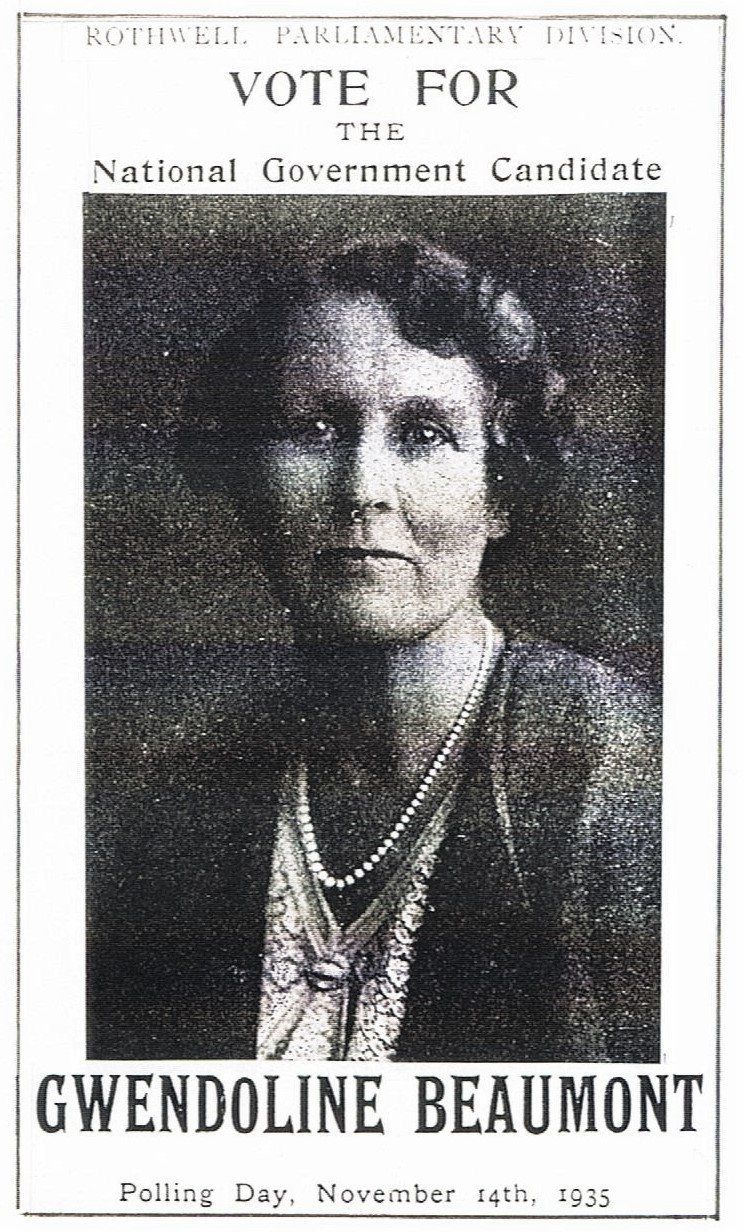
As campaigning for the 2019 General Election gets underway, I’m reminded of Gwendoline Beaumont, a doughty woman of Wakefield who stood for parliament in the dark November days of 1935. The country was beginning to emerge from the difficult economic times of the late 1920s and early 1930s, but as we know, further troubles were ahead.
With a General Election looming, it was announced in October 1935 that a woman candidate was to contest the ‘far-flung constituency’ of Rothwell for the first time. Gwendoline, although anti-suffragist before 1918, had joined the Rothwell Division of the Women’s Unionist Association, the boundaries of which included Walton and Chevet in Wakefield, and was its chairman.
A Conservative party member, Gwendoline was the only female candidate standing for the National Government (a coalition originally formed in 1931 by Ramsay McDonald). Her central campaign platform was for ‘England’ to show a united front to a distracted world, asserting that the government, having already proved its progressive policy, was worthy of the country’s trust.
Among her commitments to the electorate, these stand out:
- As a woman I know the value of family life, what our children mean to us, their health, their upbringing, the education and all the hopes we have for them. If elected I shall watch, with particular care all legislation which affects education, health, maternity welfare and the home .
- Living in the midst of the West Yorkshire coalfields I know full well how the industry suffers today from the competition of other fuel, the many new inventions which adversely affect the use of coal, and the closing of foreign markets to our exports trade. I shall most strongly support the measures which the government are pressing forward to help the industry. The present position is unfair to all and must be ended. Strikes and lockouts only mean greater hardships for the women and children .
- In these days of invention and research, far more attention ought to be given to the technical side of education, and I look forward to the granting of maintenance allowances for approved apprentices of promise. For a nation which has to maintain its standard of life by the scale and efficiency of its producers, we are perhaps paying too much attention to books and too little to the training and support of those will be the mechanics, research men, and inventors of the future.
Reminding people it was their duty to vote, she urged all those who believed in a sane, ordered and progressive policy to record their vote for her.
But could she win?
Rothwell was a staunch Labour constituency, and the incumbent MP, Mr William Lunn, had held the seat since 1918. It was a mammoth task. Undaunted by this and trailing the streets in inclement weather, Gwendoline spoke at every one of the thirty polling districts. However, attempting to convert a large working population, not in the least inclined to turn out to her meetings, was difficult. New techniques were required. Her canvassers pounced on people as they left their workplaces, they employed soap-box orators with voices that carried and they tried to round up audiences by door-knocking. Nobody said they weren’t interested, but rather than stand out in the cold and wet they just hung out of windows and peered round their back doors. ‘It’s a pity we have no hecklers,' complained one canvasser. ‘They’d all come to hear someone heckled!’
But perhaps the good people of Rothwell couldn’t bring themselves to heckle Gwendoline, who was described by a journalist as ‘a middle-aged woman of great charm, simple, restrained, unaffected, with grey blue eyes and a fair girlish complexion, well-equipped for the weather in a neat tweed suit, dark brown hat, dark brown scarf and jumper and brogues.’Of course times were different and MPs weren't subject to the same kind of abuse as they have to endure these days – so she was listened to with utmost attention and courtesy (and as the papers said, 'even by the miners').
The election took place on 14 November and with 10,000 extra voters in the constituency, there was a chance for the Conservatives to take the seat. However, a strong dislike for women candidates meant they were unlikely to vote for her. Later describing her 'enjoyable election experience', Gwendoline related how she’d often been told that a woman’s place was in the home and that’s where she ought to be. Even though she explained her family was grown up and she’d rather work than take up knitting, she could not convince them. That her campaign was doomed became apparent when she overheard one miner telling another, ‘The only woman who could get in in this division is Mae West.’
With a 75 per cent turnout, William Lunn increased his majority from 2,700 to 14,120. It was a landslide. Gwendoline acknowledged defeat, but said she was not downhearted.
And what of future women candidates?
It wasn't until the next GE, in 1945, that Yorkshire elected its first woman MP, Wakefield-born, Alice Martha Bacon, who became the Labour member for Leeds North-East until her retirement from the Commons in 1970. Still showing chauvinist tendencies, it was another forty years before the constituency elected another woman – Rachel Reeves. Rothwell has still to elect a woman MP, but happily the surrounding and shifting constituencies (whose boundaries now encompass some of the Rothwell constituency of 1935) are represented by a host of doughty Yorkshire women. I wish Tracy Brabin, Yvette Cooper, Mary Creagh and Andrea Jenkyns all the best in their campaigning.